2019 March 9, 3:00-4:30 at the stake center ward. Variety show,
Which means here is an opportunity to get on stage and make a fool of our selves and make the others laugh, And we are the guys who can do it!
We have been asked to come up with a skit.
We are going to do,or redo
DEAD SKUNK TAKE TWO
W picked this because it is easy and fun and we already have the props and costumes.
It is something all the elders can take part in.
We are going to have Bro Callan play his guitar and sing the song “ dead skunk in the middle of the road”.
And the rest of us will act it out as he plays and sings.
Bro Fjeldsted volunteered to be have the staring roll ... the skunk... then we will have some other guys playing some animals,
And whoever wants to join us as the chorus, wecanhave every elder in the building join in.
It would really help if you watch a listen to the song a few times as we want veryone to join bro Callan for the chorus.
It will be a riot.
Jan. 15, 2017 #2 An Ensign to the Nations, A light to the World
Taught by Jared Jones
Chapter 2: An Ensign to the Nations, a Light to the World
Teachings of Presidents of the Church: Gordon B. Hinckley, 2016
“This is a season to be strong. It
is a time to move forward without hesitation, knowing well the meaning,
the breadth, and the importance of our mission.”
From the Life of Gordon B. Hinckley
Soon
after returning home from his mission to England, Gordon B. Hinckley
fulfilled one last assignment from his mission president, Joseph F.
Merrill. President Merrill was also a member of the Quorum of the Twelve
Apostles, and he had asked Gordon to make a report to the First
Presidency: Presidents Heber J. Grant, J. Reuben Clark Jr., and David O.
McKay. Gordon contacted the secretary to the First Presidency and set
up an appointment.
When
Gordon entered the First Presidency’s council room, President Grant and
his counselors greeted him warmly. Then President Grant said, “Brother
Hinckley, we’ll give you fifteen minutes to tell us what Elder Merrill
wants us to hear.” One hour and fifteen minutes later, Gordon left the
room. In his allotted fifteen minutes, he had presented his mission
president’s concern—that the missionaries needed better printed
materials to help them in their work. His short presentation had led to
questions from the First Presidency and an hour-long discussion.
Having
fulfilled this assignment, Gordon felt that “his mission was now truly
over, and it was time to move ahead and plan for the future.” He had
already graduated from the University of Utah with a degree in English,
and he wanted to pursue a graduate degree in journalism at Columbia
University in New York City. But a phone call two days after his meeting
with the First Presidency changed his plans. The call was from
President McKay, who said: “Brother Hinckley, we discussed in the
meeting of the Presidency and the Twelve yesterday what we talked about
during your interview with us. And we have organized a committee
consisting of six members of the Twelve, with Elder Stephen L Richards
as chairman, to address the needs you outlined. We would like to invite
you to come and work with that committee.”1
Gordon
accepted the invitation and was hired as executive secretary of the
newly formed Church Radio, Publicity, and Mission Literature Committee.
He never went to Columbia University, and he never worked as a
journalist to publish the news of the world. Instead, he began a
lifelong effort to publish the good news of the gospel. These
responsibilities were expanded later, when he served as a General
Authority.
Having
developed the ability to express himself clearly even in difficult
situations, Gordon B. Hinckley often received assignments to be
interviewed by news reporters. As President of the Church, he continued
to welcome such opportunities, doing his part to help bring the Church
of Jesus Christ “out of obscurity” (D&C 1:30). He declared:
“I
believe and testify that it is the mission of this Church to stand as
an ensign to the nations and a light to the world. We have had placed
upon us a great, all-encompassing mandate from which we cannot shrink
nor turn aside. We accept that mandate and are determined to fulfill it,
and with the help of God we shall do it.”2
“It is the mission of this Church to stand as an ensign to the nations and a light to the world.”
Teachings of Gordon B. Hinckley
1
Like the stone in Daniel’s vision, the Church is rolling forth to fill the whole earth.
This Church began with the humble prayer of the boy Joseph Smith
in the grove of his father’s farm. From that remarkable experience,
which we call the First Vision, has grown this work. … It is the very
personification of Daniel’s vision of a stone cut out of the mountain
without hands rolling forth to fill the whole earth (see Daniel 2:44–45).3
When
the Church was organized in 1830 there were but six members [and] only a
handful of believers, all residing in a largely unknown village. …
Stakes of Zion today flourish in every state of the United States, in
every province of Canada, in every state of Mexico, in every nation of
Central America and throughout South America.
Congregations
are found throughout the British Isles and Europe, where thousands have
joined the Church through the years. This work has reached out to the
Baltic nations and on down through Bulgaria and Albania and other areas
of that part of the world. It reaches across the vast area of Russia. It
reaches up into Mongolia and all down through the nations of Asia into
the islands of the Pacific, Australia, and New Zealand, and into India
and Indonesia. It is flourishing in many of the nations of Africa. …
And this is only the beginning. This work will continue to grow and prosper and move across the earth.4
2
Early Church leaders had a prophetic view of the destiny of the Lord’s work.
On
July 24, 1847, the pioneer company of our people came into [the Salt
Lake] valley. An advance group had arrived a day or two earlier. Brigham
Young arrived on Saturday. The next day, Sabbath services were held
both in the morning and in the afternoon. There was no hall of any kind
in which to meet. I suppose that in the blistering heat of that July
Sunday they sat on the tongues of their wagons and leaned against the
wheels while the Brethren spoke. The season was late, and they were
faced with a gargantuan and immediate task if they were to grow seed for
the next season. But President Young pleaded with them not to violate
the Sabbath then or in the future.
The
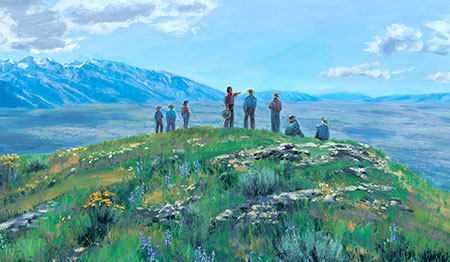
next morning they divided into groups to explore their surroundings.
Brigham Young, Wilford Woodruff, and a handful of their associates hiked
from their campground. … They climbed a dome-shaped peak, President
Young having difficulty because of his recent illness.
When
the Brethren stood on the summit, they looked over [the] valley to the
south of them. It was largely barren, except for the willows and rushes
that grew along the streams that carried water from the mountains to the
lake. There was no building of any kind, but Brigham Young had said the
previous Saturday, “This is the place.”
The
summit where they stood was named Ensign Peak out of reference to these
great prophetic words of Isaiah: “And he [speaking of God] will lift up
an ensign to the nations from far, and will hiss unto them from the end
of the earth: and, behold, they shall come with speed swiftly.” (Isa. 5:26.)
“And
he shall set up an ensign for the nations, and shall assemble the
outcasts of Israel, and gather together the dispersed of Judah from the
four corners of the earth.” (Isa. 11:12.) …
I
think [those Brethren] may also on that occasion have spoken of the
building of the temple … in fulfillment of the words of Isaiah:
“And
it shall come to pass in the last days, that the mountain of the Lord’s
house shall be established in the top of the mountains, and shall be
exalted above the hills; and all nations shall flow unto it.
“And
many people shall go and say, Come ye, and let us go up to the mountain
of the Lord, to the house of the God of Jacob; and he will teach us of
his ways, and we will walk in his paths: for out of Zion shall go forth
the law, and the word of the Lord from Jerusalem.” (Isa. 2:2–3.)
How
foolish, someone might have said, had he heard these men that July
morning of 1847. They did not look like statesmen with great dreams.
They did not look like rulers poring over maps and planning an empire.
They were exiles, driven from their fair city on the Mississippi [River]
into this desert region of the West. But they were possessed of a
vision drawn from the scriptures and words of revelation.
I
marvel at the foresight of that little group. It was both audacious and
bold. It was almost unbelievable. Here they were, almost a thousand
miles [1,600 kilometers] from the nearest settlement to the east and
almost eight hundred miles [1,300 kilometers] from the Pacific Coast.
They were in an untried climate. The soil was different from that of the
black loam of Illinois and Iowa, where they had most recently lived.
They had never raised a crop here. They had never experienced a winter.
They had not built a structure of any kind. These prophets, dressed in
old, travel-worn clothes, standing in boots they had worn for more than a
thousand miles from Nauvoo to this valley, spoke of a millennial
vision. They spoke out of a prophetic view of the marvelous destiny of
this cause. They came down from the peak that day and went to work to
bring reality to their dream.5
Two
days after arriving in the Salt Lake Valley, Brigham Young and several
other brethren climbed a dome-shaped hill, which became named Ensign
Peak, and surveyed their surroundings.
3
We must never lose sight of the divine destiny of God’s work and the part we play in it.
Sometimes
in our day, as we walk our narrow paths and fill our little niches of
responsibility, we lose sight of the grand picture. When I was a small
boy, draft horses were common. An important part of the harness was the
bridle. On the bridle were blinders, one on each side. They were so
placed that the horse could see only straight ahead and not to either
side. They were designed to keep him from becoming frightened or
distracted and to keep his attention on the road at his feet.
Some
of us do our work as if we had blinders on our eyes. We see only our
own little narrow track. We catch nothing of the broader vision. Ours
may be a small responsibility in the Church. It is good to fulfill that
responsibility with diligence. And it is also good to know how that
responsibility contributes to the great overall program of the growing
kingdom of God.
President Harold B. Lee once said … , quoting an unknown writer, “Survey large fields and cultivate small ones.”
My
interpretation of that statement is that we ought to recognize
something of the breadth and depth and height—grand and wonderful, large
and all-encompassing—of the program of the Lord, and then work with
diligence to meet our responsibility for our assigned portion of that
program.
Each
of us has a small field to cultivate. While so doing, we must never
lose sight of the greater picture, the large composite of the divine
destiny of this work. It was given us by God our Eternal Father, and
each of us has a part to play in the weaving of its magnificent
tapestry. Our individual contribution may be small, but it is not
unimportant. …
… While
you are performing the part to which you have been called, never lose
sight of the whole majestic and wonderful picture of the purpose of
this, the dispensation of the fulness of times. Weave beautifully your
small thread in the grand tapestry, the pattern for which was laid out
for us by the God of heaven. Hold high the standard under which we walk.
Be diligent, be true, be virtuous, be faithful, that there may be no
flaw in that banner.
The
vision of this kingdom is not a superficial dream in the night that
fades with the sunrise. It is veritably the plan and work of God our
Eternal Father. It has to do with all of His children.
While
grubbing the sagebrush of these western valleys [of Utah] to lay the
foundations for a commonwealth, while doing all of the many mundane
things they were required to do to stay alive and grow, our [pioneer]
forebears ever kept before them the grandeur of the great cause in which
they were engaged. It is a work which we must do with the same vision
they held. It is a work which will go on after we have left this scene.
God help us to do our very best as servants, called under His divine
will, to carry forward and build the kingdom with imperfect hands,
united together to execute a perfect pattern.6
4
We can become as an ensign to the nations from which the people of the earth may gather strength.
My
brethren and sisters, the time has come for us to stand a little
taller, to lift our eyes and stretch our minds to a greater
comprehension and understanding of the grand millennial mission of this
The Church of Jesus Christ of Latter-day Saints. This is a season to be
strong. It is a time to move forward without hesitation, knowing well
the meaning, the breadth, and the importance of our mission. It is a
time to do what is right regardless of the consequences that might
follow. It is a time to be found keeping the commandments. It is a
season to reach out with kindness and love to those in distress and to
those who are wandering in darkness and pain. It is a time to be
considerate and good, decent and courteous toward one another in all of
our relationships. In other words, to become more Christlike.7
Unless
the world alters the course of its present trends (and that is not
likely); and if, on the other hand, we continue to follow the teachings
of the prophets, we shall increasingly become a peculiar and distinctive
people of whom the world will take note. For instance, as the integrity
of the family
crumbles under worldly pressures, our position on the sanctity of the
family will become more obvious and even more peculiar in contrast, if
we have the faith to maintain that position.
As
the growing permissive attitude toward sex continues to spread, the
doctrine of the Church, as consistently taught for more than a century
and a half, will become increasingly singular and even strange to many.
As
the consumption of alcohol and the abuse of drugs increase each year
within the mores of our society, our position, set forth by the Lord
more than a century and a half ago, will become more unusual before the
world. …
As
the Sabbath increasingly becomes a day of merchandising and
entertainment, those who obey the precept of the law, written by the
finger of the Lord on Sinai and reinforced by modern revelation, will
appear more unusual.
It
is not always easy to live in the world and not be a part of it. We
cannot live entirely with our own or unto ourselves, nor would we wish
to. We must mingle with others. In so doing, we can be gracious. We can
be inoffensive. We can avoid any spirit or attitude of
self-righteousness. But we can maintain our standards. …
As
we observe these and other standards taught by the Church, many in the
world will respect us and find strength to follow that which they too
know is right.
And,
in the words of Isaiah, “Many people shall go and say, Come ye, and let
us go up to the mountain of the Lord, to the house of the God of Jacob;
and he will teach us of his ways, and we will walk in his paths.” (Isa. 2:3.)
We
need not compromise. We must not compromise. The candle that the Lord
has lighted in this dispensation can become as a light unto the whole
world, and others seeing our good works can be led to glorify our Father
in Heaven and emulate in their own lives the examples they have
observed in ours.
Beginning
with you and me, there can be an entire people who, by the virtue of
our lives in our homes, in our vocations, even in our amusements, can
become as a city upon a hill to which men may look and learn, and an
ensign to the nations from which the people of the earth may gather
strength.8
If
we are to hold up this Church as an ensign to the nations and a light
to the world, we must take on more of the luster of the life of Christ
individually and in our own personal circumstances. In standing for the
right, we must not be fearful of the consequences. We must never be
afraid. Said Paul to Timothy:
“For God hath not given us the spirit of fear; but of power, and of love, and of a sound mind.
“Be not thou therefore ashamed of the testimony of our Lord” (2 Timothy 1:7–8).9
You
cannot simply take for granted this cause, which is the cause of
Christ. You cannot simply stand on the sidelines and watch the play
between the forces of good and evil. …
… I
urge you with all the capacity that I have to reach out in a duty that
stands beyond the requirements of our everyday lives; that is, to stand
strong, even to become a leader in speaking up in behalf of those causes
which make our civilization shine and which give comfort and peace to
our lives. You can be a leader. You must be a leader, as a member of
this Church, in those causes for which this Church stands. Do not let
fear overcome your efforts.10
We
have nothing to fear. God is at the helm. He will overrule for the good
of this work. He will shower down blessings upon those who walk in
obedience to His commandments. Such has been His promise. Of His ability
to keep that promise none of us can doubt.
… Our
Savior, who is our Redeemer, the Great Jehovah, the mighty Messiah, has
promised: “I will go before your face. I will be on your right hand and
on your left, and my Spirit shall be in your hearts, and mine angels
round about you, to bear you up” (D&C 84:88).
“Therefore,”
said He, “fear not, little flock; do good; let earth and hell combine
against you, for if ye are built upon my rock, they cannot prevail. …
“Look unto me in every thought; doubt not, fear not.
“Behold
the wounds which pierced my side, and also the prints of the nails in
my hands and feet; be faithful, keep my commandments, and ye shall
inherit the kingdom of heaven” (D&C 6:34, 36–37).
Unitedly,
working hand in hand, we shall move forward as servants of the living
God, doing the work of His Beloved Son, our Master, whom we serve and
whose name we seek to glorify.11
We
must stand firm. We must hold back the world. If we do so, the Almighty
will be our strength and our protector, our guide and our revelator. We
shall have the comfort of knowing that we are doing what He would have
us do. Others may not agree with us, but I am confident that they will
respect us. We will not be left alone. There are many [who are] not of
our faith but who feel as we do. They will support us. They will sustain
us in our efforts.12
Let
us glory in this wonderful season of the work of the Lord. Let us not
be proud or arrogant. Let us be humbly grateful. And let us, each one,
resolve within himself or herself that we will add to the luster of this
magnificent work of the Almighty, that it may shine across the earth as
a beacon of strength and goodness for all the world to look upon.13
“If
we are to hold up this Church as an ensign to the nations and a light
to the world, we must take on more of the luster of the life of Christ.”
Suggestions for Study and Teaching
Questions
•
As you read section 1, what are your feelings as you consider the growth of the Church from 1830 to the present day?
•
Review
President Hinckley’s account of the first pioneers arriving in the Salt
Lake Valley (see section 2). What can we learn from this account? How
have we benefited from the prophetic vision of early Church leaders?
What do you think it means to be “an ensign to the nations”? (See Isaiah 5:26; 11:12.)
•
In
section 3, President Hinckley encouraged us to see the “grand picture”
and “broader vision” of God’s work. Why do we need to see this grand
picture? Why do we sometimes lose sight of it? In what ways can our
small efforts contribute to the growth of God’s kingdom?
•
Review
the ways President Hinckley says Latter-day Saints are becoming a more
“peculiar and distinctive people” (section 4). How can we develop
greater vision and courage in moving God’s work forward? How can we live
in the world without being of the world? How can we “take on more of
the luster of the life of Christ”? Why is it important for us to stand
for what is right?
“Be
sure you don’t believe you are the ‘true teacher.’ That is a serious
mistake. … Be careful you do not get in the way. The major role of a
teacher is to prepare the way such that the people will have a spiritual
experience with the Lord” (Gene R. Cook, quoted in Teaching, No Greater Call [1999], 41).
Chapter 1: The Restoration of the Gospel—The Dawning of a Brighter Day
Teachings of Presidents of the Church: Gordon B. Hinckley, 2016
“This glorious gospel was ushered in
with the appearance of the Father and the Son to the boy Joseph.”
From the Life of Gordon B. Hinckley
Throughout
his life, President Gordon B. Hinckley fostered a deep respect for the
people and places involved in the restoration of the gospel. He felt
special gratitude for Joseph Smith
and his role in the Restoration, and he spoke of “an ever-growing
compulsion to bear testimony of the divinity of the Lord and of the
mission of the Prophet Joseph Smith.”1
In
1935, when Gordon was traveling home from his mission to England, he
and other returning missionaries visited the Sacred Grove and the Hill
Cumorah. They also stopped at Carthage Jail, where the Prophet Joseph
and Hyrum Smith were martyred. They walked the dusty streets of Nauvoo,
where exiled Saints had turned a swampland into a beautiful city.
Undoubtedly, reflections on the trials and triumphs of the early Saints
pressed upon Gordon’s mind while he was in these places and as he
continued west along the pioneer route to Salt Lake City.
Gordon B.
Hinckley returned to the sacred sites of the Restoration many more
times in the following decades. At the First Presidency Christmas
devotional on December 3, 2000, he shared this personal experience from a
visit to the Sacred Grove:
“Some
years ago I was assigned to the Rochester New York Stake conference. On
Saturday I said to the brethren who were with me, ‘Let us get up early
in the morning, early Sunday morning, and go to the Sacred Grove before
the conference.’ They all agreed. Accordingly, very early on that spring
Sabbath, the mission president, the stake president, the regional
representative, and I went out to Palmyra and walked into the grove. No
one else was there. It was peaceful and beautiful. It had rained during
the night. Tiny new leaves were upon the trees.
“We
spoke quietly one to another. We knelt upon the damp ground and prayed.
We did not hear an audible voice. We did not see a vision. But in an
indefinable way we were told in our minds, each of us, that yes, it
happened here just as Joseph said it happened. It was here that God our
Eternal Father and His Beloved Son, the resurrected Lord Jesus Christ,
appeared to the 14-year-old boy and spoke with him. Their matchless
light rested upon him, and he was instructed in what he should do.
“That
sublime occasion, the First Vision, parted the curtains through which
came the restoration to earth of the Church of Christ. It came out of
the wilderness of darkness, out of the bleakness of ages past into the
glorious dawn of a new day. The Book of Mormon
followed as another witness of the Lord Jesus Christ. His holy supernal
priesthood was restored under the hands of those who held it anciently.
Keys and powers were bestowed upon the Prophet and his associates. The
ancient Church was again upon the earth with all of the blessings,
powers, doctrines, keys, and principles of previous dispensations. It is
[Christ’s] Church. It carries His name. It is governed by His
priesthood. There is no other name under heaven by which men must be
saved. Joseph Smith … became His great testator.”2
The First Vision began “the final chapter in the long chronicle of God’s dealing with men and women upon the earth.”
Teachings of Gordon B. Hinckley
1
Following the Savior’s death, the Church He had established drifted into apostasy.
[Jesus Christ] was and is the great central figure of human history, the zenith of the times and seasons of all men.
Before His death, He had ordained His Apostles. They carried on for a period. His Church was set in place.3
Following
the Savior’s death, the Church He had established drifted into
apostasy. Fulfilled were the words of Isaiah, who said, “The earth also
is defiled under the inhabitants thereof; because they have transgressed
the laws, changed the ordinance, broken the everlasting covenant” (Isaiah 24:5).4
Paul’s
letters cried out for strength among the followers of Christ, lest they
fall into the ways of the wicked one. But a spirit of apostasy
ultimately prevailed.5
The
centuries rolled on. A cloud of darkness settled over the earth. Isaiah
described it: “For, behold, the darkness shall cover the earth, and
gross darkness the people” (Isa. 60:2).
It
was a season of plunder and suffering, marked by long and bloody
conflict. … It was an age of hopelessness, a time of masters and serfs.
The
first thousand years passed, and the second millennium dawned. Its
earlier centuries were a continuation of the former. It was a time
fraught with fear and suffering.6
2
The Renaissance and Reformation helped prepare the way for the restoration of the gospel.
Somehow,
in that long season of darkness, a candle was lighted. The age of
Renaissance brought with it a flowering of learning, art, and science.
There came a movement of bold and courageous men and women who looked
heavenward in acknowledgment of God and His divine Son. We speak of it
as the Reformation.7
Reformers worked to change the [Christian]
church, notably such men as Luther, Melanchthon, Hus, Zwingli, and
Tyndale. These were men of great courage, some of whom suffered cruel
deaths because of their beliefs. Protestantism was born with its cry for
reformation. When that reformation was not realized, the reformers
organized churches of their own. They did so without priesthood
authority. Their one desire was to find a niche in which they might
worship God as they felt He should be worshiped.
While
this great ferment was stirring across the Christian world, political
forces were also at work. Then came the American Revolutionary War,
resulting in the birth of a nation whose Constitution declared that
government should not reach its grasping hand into matters of religion. A
new day had dawned, a glorious day. Here there was no longer a state
church. No one faith was favored above another.
After
centuries of darkness and pain and struggle, the time was ripe for the
restoration of the gospel. Ancient prophets had spoken of this
long-awaited day.
All
of the history of the past had pointed to this season. The centuries
with all of their suffering and all their hope had come and gone. The
Almighty Judge of the nations, the Living God, determined that the times
of which the prophets had spoken had arrived. Daniel had foreseen a
stone which was cut out of the mountain without hands and which became a
great mountain and filled the whole earth [see Daniel 2:35, 44].8
3
The Restoration was ushered in with the appearance of the Father and the Son to Joseph Smith.
After
many generations had walked the earth—so many of them in conflict,
hatred, darkness, and evil—there arrived the great, new day of the
Restoration. This glorious gospel was ushered in with the appearance of
the Father and the Son to the boy Joseph.9
How
truly remarkable was that vision in the year 1820 when Joseph prayed in
the woods and there appeared before him both the Father and the Son.
One of these spoke to him, calling him by name and, pointing to the
other, said, “This is My Beloved Son. Hear Him!” (Joseph Smith—History 1:17).
Nothing
like it had ever happened before. One is led to wonder why it was so
important that both the Father and the Son appear. I think it was
because They were ushering in the dispensation of the fulness of times,
the last and final dispensation of the gospel, when there would be
gathered together in one the elements of all previous dispensations.
This was to be the final chapter in the long chronicle of God’s dealing
with men and women upon the earth.10
Every
claim that we make concerning divine authority, every truth that we
offer concerning the validity of this work, all finds its root in the
First Vision of the boy prophet. Without it we would not have anything
much to say. This was the great curtain-raiser on the dispensation of
the fulness of times, when God promised that He would restore all the
power, the gifts, the blessings, of all previous dispensations.11
4
Priesthood authority and keys were restored.
The authority and keys of the Melchizedek Priesthood were restored to the earth as part of the Restoration.
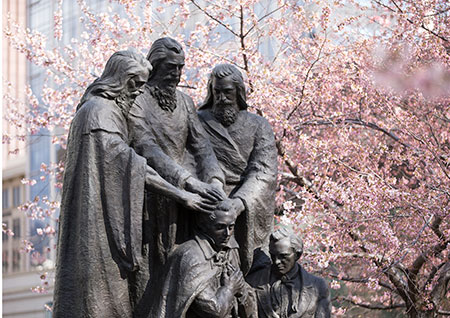
In
restoring the Aaronic Priesthood, the resurrected John the Baptist laid
his hands on the heads of Joseph Smith and Oliver Cowdery and said,
“Upon you my fellow servants, in the name of Messiah I confer the
Priesthood of Aaron, which holds the keys of the ministering of angels,
and of the gospel of repentance, and of baptism by immersion for the remission of sins” (D&C 13:1).12
This
was followed by a visitation of Peter, James, and John, Apostles of the
Lord Jesus Christ, who conferred upon Joseph and Oliver Cowdery the
Melchizedek Priesthood, which had been received by these Apostles under
the hands of the Lord Himself.13
Three
of [the Savior’s] Apostles—Peter, James, and John—appeared to Joseph
and Oliver somewhere “in the wilderness” along the Susquehanna River
(see D&C 128:20). They placed their hands upon their heads and conferred upon them this holy authority. …
I
can trace my priesthood in a direct line to this event. It goes as
follows: I was ordained by David O. McKay; who was ordained by Joseph F.
Smith; who was ordained by Brigham Young; who was ordained by the Three
Witnesses; who were ordained by Joseph Smith Jr. and Oliver Cowdery;
who were ordained by Peter, James, and John; who were ordained by the
Lord Jesus Christ.
It
has similarly come to [each Melchizedek Priesthood holder]. Each of you
brethren who hold this priesthood has also received it in a direct line
from the bestowal made by Peter, James, and John.14
5
Through Joseph Smith, the Lord revealed truths that distinguish us from other churches.
Permit
me to name a few of many doctrines and practices which distinguish us
from all other churches, and all of which have come of revelation to the
youthful Prophet. They are familiar to you, but they are worth
repeating and reflecting on.
The Godhead
The
first of these … is the manifestation of God Himself and His Beloved
Son, the risen Lord Jesus Christ. This grand theophany is, in my
judgment, the greatest such event since the birth, life, death, and Resurrection of our Lord in the meridian of time.
We have no record of any other event to equal it.
For
centuries men gathered and argued concerning the nature of Deity.
Constantine assembled scholars of various factions at Nicaea in the year
325. After two months of bitter debate, they compromised on a
definition which for generations has been the doctrinal statement among
Christians concerning the Godhead.
I
invite you to read that definition and compare it with the statement of
the boy Joseph. He simply says that God stood before him and spoke to
him. Joseph could see Him and could hear Him. He was in form like a man,
a being of substance. Beside Him was the resurrected Lord, a separate
being, whom He introduced as His Beloved Son and with whom Joseph also
spoke.
I
submit that in the short time of that remarkable vision Joseph learned
more concerning Deity than all of the scholars and clerics of the past.
In this divine revelation there was reaffirmed beyond doubt the reality of the literal Resurrection of the Lord Jesus Christ.
This
knowledge of Deity, hidden from the world for centuries, was the first
and great thing which God revealed to His chosen servant.15
The Book of Mormon as a companion witness with the Bible
“The Book of Mormon … speaks as a voice from the dust in testimony of the Son of God.”
I speak next of another very important thing which God revealed.
The Christian world accepts the Bible as the word of God. Most have no idea of how it came to us.
I
have just completed reading a newly published book by a renowned
scholar. It is apparent from information which he gives that the various
books of the Bible were brought together in what appears to have been
an unsystematic fashion. In some cases, the writings were not produced
until long after the events they describe. One is led to ask, “Is the
Bible true? Is it really the word of God?”
We
reply that it is, insofar as it is translated correctly. The hand of
the Lord was in its making. But it now does not stand alone. There is
another witness of the significant and important truths found therein.
Scripture declares that “in the mouth of two or three witnesses shall every word be established” (2 Corinthians 13:1).
The
Book of Mormon has come forth by the gift and power of God. It speaks
as a voice from the dust in testimony of the Son of God. It speaks of
His birth, of His ministry, of His Crucifixion and Resurrection, and of
His appearance to the righteous in the land Bountiful on the American
continent.
It
is a tangible thing that can be handled, that can be read, that can be
tested. It carries within its covers a promise of its divine origin.
Millions now have put it to the test and found it to be a true and
sacred record. …
As
the Bible is the testament of the Old World, the Book of Mormon is the
testament of the New. They go hand in hand in declaration of Jesus as
the Son of the Father. …
This sacred book, which came forth as a revelation of the Almighty, is indeed another testament of the divinity of our Lord.16
Priesthood authority and Church organization
Priesthood
is the authority to act in the name of God. … I have read [a] book
recently [that] deals with the Apostasy of the primitive Church. If the
authority of that Church was lost, how was it to be replaced?
Priesthood
authority came from the only place it could come, and that is from
heaven. It was bestowed under the hands of those who held it when the
Savior walked the earth. …
How
beautiful is the unfolding of the pattern of restoration which led to
the organization of the Church in the year 1830. … The very name of the
Church came of revelation. Whose Church was it? Was it Joseph Smith’s?
Was it Oliver Cowdery’s? No, it was the Church of Jesus Christ restored
to earth in these latter days.17
Another great and singular revelation given to the Prophet was the plan for the eternal life of the family.
The
family is a creation of the Almighty. It represents the most sacred of
all relationships. It represents the most serious of all undertakings.
It is the fundamental organization of society.
Through
the revelations of God to His Prophet came the doctrine and authority
under which families are sealed together not only for this life but for
all eternity.18
The innocence of little children
The
innocence of little children is another revelation which God has given
through the instrumentality of the Prophet Joseph. The general practice
is the baptism of infants to take away the effects of what is described
as the sin of Adam and Eve. Under the doctrine of the Restoration,
baptism is for the remission of one’s individual and personal sins. It
becomes a covenant between God and man. It is performed at the age of
accountability, when people are old enough to recognize right from
wrong. It is by immersion, in symbolism of the death and burial of Jesus
Christ and His coming forth in the Resurrection.19
Salvation for the dead
I
go on to mention another revealed truth. We are told that God is no
respecter of persons, and yet, in no other church of which I am aware,
is provision made for those beyond the veil of death to receive every
blessing which is afforded the living. The great doctrine of salvation
for the dead is unique to this Church. … The dead are given the same
opportunity as the living. Again, what a glorious and wonderful
provision the Almighty has made through His revelation to His Prophet.20
The nature, purpose, and potential of God’s children
The
eternal nature of man has been revealed. We are sons and daughters of
God. God is the Father of our spirits. We lived before we came here. We
had personality. We were born into this life under a divine plan. We are
here to test our worthiness, acting in the agency which God has given
to us. When we die we shall go on living. Our eternal life is comprised
of three phases: one, our premortal existence; two, our mortal
existence; and three, our postmortal existence. In death we die to this
world and step through the veil into the sphere we are worthy to enter.
This, again, is a unique, singular, and precious doctrine of this Church
which has come through revelation.21
Modern revelation
I
offer this brief summary of the tremendous outpouring of knowledge and
authority from God upon the head of His Prophet. … There is one more
that I must mention. This is the principle of modern revelation. The
article of faith which the Prophet wrote declares:
“We
believe all that God has revealed, all that He does now reveal, and we
believe that He will yet reveal many great and important things
pertaining to the Kingdom of God” (Articles of Faith 1:9).
A
growing church, a church that is spreading across the earth in these
complex times, needs constant revelation from the throne of heaven to
guide it and move it forward.
With
prayer and anxious seeking of the will of the Lord, we testify that
direction is received, that revelation comes, and that the Lord blesses
His Church as it moves on its path of destiny.
On
the solid foundation of the Prophet Joseph’s divine calling and the
revelations of God, which came through him, we go forward.22
Standing
as the 15th in line from Joseph Smith and bearing the prophetic mantle
which came upon him, I solemnly declare my testimony that the Prophet
Joseph’s account of [the events of the Restoration] is true, that the
Father … bore witness of the divinity of His Son, that the Son
instructed the boy prophet, and that there followed a train of events
which led to the organization of “the only true and living church upon
the face of the whole earth” [D&C 1:30].23
Suggestions for Study and Teaching
Questions
•
Why
did the people of the world need the Church and gospel of Jesus Christ
to be restored? (See section 1.) What are some ways the Lord prepared
the way for the restoration of the gospel? (See section 2.)
•
Ponder
President Hinckley’s teachings about the First Vision (see section 3).
In what ways has your testimony of the First Vision influenced you?
•
Why
was it necessary that the priesthood be restored by heavenly
messengers? (See section 4.) Why is important that Melchizedek
Priesthood holders can trace their priesthood authority to Jesus Christ?
•
In
section 5, review the summary of some of the truths that came by
revelation to the Prophet Joseph Smith. How have these truths blessed
your life? How might we help children understand and appreciate these
truths?
“Your gospel study is most effective when you are taught by the Holy Ghost. Always begin your gospel study by praying for the Holy Ghost to help you learn” (Preach My Gospel [2004], 18).
Teachings of Presidents of the Church: Howard W. Hunter, 2015
“Most of us will be quiet,
relatively unknown folks who … do our work without fanfare. To those of
you who may find that … unspectacular, I say, you are ‘no less
serviceable’ than the most spectacular of your associates.”
From the Life of Howard W. Hunter
President
Howard W. Hunter was known not only as a dedicated leader and beloved
prophet, but also for the quiet way in which he served. He knew that the
service itself was important, not whether he received any recognition.
Elder Neal A. Maxwell of the Quorum of the Twelve once said of him,
“President Howard W. Hunter is a meek man. … This is the same lowly man,
when I awakened after a weary and dusty day together with him on
assignment in Egypt, who was quietly shining my shoes, a task he had
hoped to complete unseen.”1
President
Thomas S. Monson first noticed President Hunter’s humble way of serving
when the Los Angeles California Temple was dedicated in 1956, several
years before either of them was called as an Apostle. He recalled:
“My
… introduction to President Hunter was when he served as president of
the Pasadena California Stake and had responsibility to coordinate local
arrangements for the dedication of the Los Angeles (California) Temple.
It was my privilege to print the tickets. His assignment was mammoth. I
saw only that portion which pertained to the tickets, which were color
coded, intricately labeled, and numbered in the most orderly fashion I
had ever seen. He generously gave credit to others and insured that his
name was not excessively featured, even though he had been a driving
force behind these monumental undertakings.”2
Elder
James E. Faust of the Quorum of the Twelve further observed: “He had no
ego needs. With all his wisdom, he could sit among his brethren and say
very little. He was at complete peace with himself.”3
President
Hunter understood that every act of service is important in God’s eyes,
no matter how unheralded or inconspicuous. Several weeks before
President Hunter passed away, a friend asked, “Dear President, what is
the most exalted position or calling—that of a dear and trusted friend,
or that of a prophet of God?” After hearing the question, “the President
pondered silently for what seemed like minutes; then slowly grasping
the hand of his friend and turning his head squarely toward him, with a
tear trickling down his frail cheek, he responded, ‘they are both sacred callings of trust.’”4
Life-changing service is rendered by many “who are not seen in the limelight, who do not receive the attention of the world.”
Teachings of Howard W. Hunter
1
Those who serve quietly and inconspicuously are “no less serviceable” than those who receive the world’s acclaim.
It
was said of the young and valiant Captain Moroni: “If all men had been,
and were, and ever would be, like unto Moroni, behold, the very powers
of hell would have been shaken forever; yea, the devil would never have
power over the hearts of the children of men.” (Alma 48:17.)
What
a compliment to a famous and powerful man! I can’t imagine a finer
tribute from one man to another. Two verses later is a statement about
Helaman and his brethren, who played a less conspicuous role than
Moroni: “Now behold, Helaman and his brethren were no less serviceable
unto the people than was Moroni.” (Alma 48:19.)
In
other words, even though Helaman was not as noticeable or conspicuous
as Moroni, he was as serviceable; that is, he was as helpful or useful
as Moroni.
Obviously,
we could profit greatly by studying the life of Captain Moroni. He is
an example of faith, service, dedication, commitment, and many other
godly attributes. Rather than focusing on this magnificent man, however,
I have chosen to look instead at those who are not seen in the
limelight, who do not receive the attention of the world, yet who are
“no less serviceable,” as the scripture phrased it.
Not
all of us are going to be like Moroni, catching the acclaim of our
colleagues all day every day. Most of us will be quiet, relatively
unknown folks who come and go and do our work without fanfare. To those
of you who may find that [thought] lonely or frightening or just
unspectacular, I say, you are “no less serviceable” than the most
spectacular of your associates. You, too, are part of God’s army.
Consider,
for example, the profound service a mother or father gives in the quiet
anonymity of a worthy Latter-day Saint home. Think of the Gospel
Doctrine teachers and Primary choristers and Scoutmasters and Relief
Society visiting teachers who serve and bless millions but whose names
will never be publicly applauded or featured in the nation’s media.
Tens
of thousands of unseen people make possible our opportunities and
happiness every day. As the scriptures state, they are “no less
serviceable” than those whose lives are on the front pages of
newspapers.
The limelight of history and contemporary attention so often focuses on the one rather than on the many.
Individuals are frequently singled out from their peers and elevated as
heroes. I acknowledge that this kind of attention is one way to
identify that which the people admire or hold to be of some value. But
sometimes that recognition is not deserved, or it may even celebrate the
wrong values.
We
must choose wisely our heroes and examples, while also giving thanks
for those legions of friends and citizens who are not so famous but who
are “no less serviceable” than the Moronis of our lives.5
2
In the scriptures, many people who served in the shadow of others made important contributions.
Perhaps
you could consider with me some interesting people from the scriptures
who did not receive the limelight of attention but who, through the long
lens of history, have proven themselves to be truly heroic.
Many
who read the story of the great prophet Nephi almost completely miss
another valiant son of Lehi whose name was Sam. Nephi is one of the most
famous figures in the entire Book of Mormon. But Sam? Sam’s name is mentioned there only ten times. When Lehi counseled and blessed his posterity, he said to Sam:
“Blessed
art thou, and thy seed; for thou shalt inherit the land like unto thy
brother Nephi. And thy seed shall be numbered with his seed; and thou
shalt be even like unto thy brother, and thy seed like unto his seed;
and thou shalt be blessed in all thy days.” (2 Ne. 4:11.)
Sam’s
role was basically one of supporting and assisting his more acclaimed
younger brother, and he ultimately received the same blessings promised
to Nephi and his posterity. Nothing promised to Nephi was withheld from
the faithful Sam, yet we know very little of the details of Sam’s
service and contribution. He was an almost unknown person in life, but
he is obviously a triumphant leader and victor in the annals of
eternity.
Many make their contributions in unsung ways. Ishmael traveled with the family of Nephi at great personal sacrifice, suffering “much affliction, hunger, thirst, and fatigue.” (1 Ne. 16:35.)
Then in the midst of all of these afflictions, he perished in the
wilderness. Few of us can even begin to understand the sacrifice of such
a man in those primitive times and conditions. Perhaps if we were more
perceptive and understanding, we too would mourn, as his daughters did
in the wilderness, for what a man like this gave—and gave up!—so that we
could have the Book of Mormon today.
The
names and memories of such men and women who were “no less serviceable”
are legion in the Book of Mormon. Whether it be Mother Sariah or the
maid Abish, servant to the Lamanite queen, each made contributions that
were unacknowledged by the eyes of men but not unseen by the eyes of
God.
We
have only twelve verses of scripture dealing with the life of Mosiah,
king over the land of Zarahemla and father of the famous King Benjamin.
Yet his service to the people was indispensable. He led the people “by
many preachings and prophesyings” and “admonished [them] continually by
the word of God.” (Omni 1:13.)
Limhi, Amulek, and Pahoran—the latter of whom had the nobility of soul
not to condemn when he was very unjustly accused—are other examples of
people who served selflessly in the shadow of others’ limelight.
The
soldier Teancum, who sacrificed his own life, or Lachonius, the chief
judge who taught people to repent during the challenge of the
Gadiantons, or the virtually unmentioned missionaries Omner and Himni,
were all “no less serviceable” than their companions, yet they received
very little scriptural attention.
We
don’t know much about Shiblon, the faithful son of Alma whose story is
sandwiched between those of Helaman, the future leader, and Corianton,
the transgressor; but it is significant that he is described as a “just
man [who] did walk uprightly before God.” (Alma 63:2.)
The great prophet Nephi, mentioned in the book of Helaman, had a
brother named Lehi, who is seemingly mentioned only in passing but is
noted as being “not a whit behind [Nephi] as to things pertaining to
righteousness.” [Helaman 11:19; see also verse 18.]6
After Abish (left) touched the hand of the Lamanite queen, the queen arose from the ground (see Alma 19:15–29).
3
Even though we may not be well known, we can render great service in the kingdom.
Of
course, there are examples of these serviceable individuals in our
dispensation as well. Oliver Granger is the kind of quiet, supportive
individual in the latter days that the Lord remembered in section 117 of
the Doctrine and Covenants. Oliver’s name may be unfamiliar to many, so I will take the liberty to acquaint you with this early stalwart.
Oliver Granger was eleven years older than Joseph Smith
and, like the Prophet, was from upstate New York. Because of severe
cold and exposure when he was thirty-three years old, Oliver lost much
of his eyesight. Notwithstanding his limited vision, he served three
full-time missions. He also worked on the Kirtland Temple and served on
the Kirtland high council.
When
most of the Saints were driven from Kirtland, Ohio, the Church left
some debts unsatisfied. Oliver was appointed to represent Joseph Smith
and the First Presidency by returning to Kirtland to settle the Church’s
business. Of this task, the Doctrine and Covenants records: “Therefore,
let him contend earnestly for the redemption of the First Presidency of
my Church, saith the Lord.” (D&C 117:13.)
He
performed this assignment with such satisfaction to the creditors
involved that one of them wrote: “Oliver Granger’s management in the
arrangement of the unfinished business of people that have moved to the
Far West, in redeeming their pledges and thereby sustaining their
integrity, has been truly praiseworthy, and has entitled him to my
highest esteem, and every grateful recollection.” (Horace Kingsbury, as
cited in Joseph Smith, History of the Church, 3:174.)
During
Oliver’s time in Kirtland, some people, including disaffected members
of the Church, were endeavoring to discredit the First Presidency and
bring their integrity into question by spreading false accusations.
Oliver Granger, in very deed, “redeemed the First Presidency” through
his faithful service. … The Lord said of Oliver Granger: “His name shall
be had in sacred remembrance from generation to generation, forever and
ever.” (D&C 117:12.)
“I will lift up my servant Oliver, and beget for him a great name on
the earth, and among my people, because of the integrity of his soul.” (History of the Church, 3:350.)
When
he died in 1841, even though there were but few Saints remaining in the
Kirtland area and even fewer friends of the Saints, Oliver Granger’s
funeral was attended by a vast concourse of people from neighboring
towns.
Though
Oliver Granger is not as well known today as other early leaders of the
Church, he was nevertheless a great and important man in the service he
rendered to the kingdom. And even if no one but the Lord had his name
in remembrance, that would be a sufficient blessing for him—or for any
of us.7
4
Nephi is an example of remembering God as the source of his strength and blessings.
I
think we should be aware that there can be a spiritual danger to those
who misunderstand the singularity of always being in the spotlight. They
may come to covet the notoriety and thus forget the significance of the
service being rendered.
We
must not allow ourselves to focus on the fleeting light of popularity
or substitute that attractive glow for the substance of true but often
anonymous labor that brings the attention of God, even if it does not
get coverage on the six o’clock news. In fact, applause and attention
can become the spiritual Achilles’ heels of even the most gifted among
us.
If
the limelight of popularity should fall on you sometime in your life,
it might be well for you to follow the example of those in the
scriptures who received fame. Nephi is one of the great examples. After
all he accomplished traveling in the wilderness with his family, his
attitude was still fixed on the things that matter most. He said:
“And when I desire to rejoice, my heart groaneth because of my sins; nevertheless, I know in whom I have trusted.
“My
God hath been my support; he hath led me through mine afflictions in
the wilderness; and he hath preserved me upon the waters of the great
deep.
“He hath filled me with his love, even unto the consuming of my flesh.
“He hath confounded mine enemies, unto the causing of them to quake before me.” (2 Ne. 4:19–22.)
The limelight never blinded Nephi as to the source of his strength and his blessings.8
5
When we understand why we serve, we won’t be concerned about where we serve.
At
times of attention and visibility, it might also be profitable for us
to answer the question, Why do we serve? When we understand why, we
won’t be concerned about where we serve.
President
J. Reuben Clark, Jr., taught this vital principle in his own life. At
general conference in April 1951, President David O. McKay was sustained
as President of the Church after the passing of President George Albert
Smith. Up to that time, President Clark had served as the First
Counselor to President Heber J. Grant and then to President George
Albert Smith. President McKay had been the Second Counselor to both men.
During
the final session of conference when the business of the Church was
transacted, Brother Stephen L Richards was called to the First
Presidency and sustained as First Counselor. President J. Reuben
Clark, Jr., was then sustained as the Second Counselor. After the
sustaining of the officers of the Church, President McKay explained why
he had chosen his counselors in that order. He said:
“I
felt that one guiding principle in this choice would be to follow the
seniority in the Council [of the Twelve]. These two men were sitting in
their places in that presiding body in the Church, and I felt impressed
that it would be advisable to continue that same seniority in the new
quorum of the First Presidency.” (In Conference Report, 9 April 1951, p.
151.)
President
Clark was then asked to speak following President McKay. His remarks on
this occasion were brief but teach a powerful lesson: “In the service
of the Lord, it is not where you serve but how. In The Church of Jesus Christ
of Latter-day Saints, one takes the place to which one is duly called,
which place one neither seeks nor declines. I pledge to President McKay
and to President Richards the full loyal devoted service to the tasks
that may come to me to the full measure of my strength and my abilities,
and so far as they will enable me to perform them, however inadequate I
may be.” (Ibid., p. 154.)
The
lesson that President Clark taught is expressed in another way in this
poem by Meade McGuire, which has been repeated many times:
“Father, where shall I work today?”
And my love flowed warm and free.
Then He pointed out a tiny spot
And said, “Tend that for me.”
I answered quickly, “Oh no; not that!
Why, no one would ever see,
No matter how well my work was done;
Not that little place for me.”
And the word He spoke, it was not stern;
He answered me tenderly:
“Ah, little one, search that heart of thine.
Art thou working for them or for me?
Nazareth was a little place,
And so was Galilee.”
[See Best-Loved Poems of the LDS People, comp. Jack M. Lyon and others (1996), 152.]
King
Benjamin declared: “Behold, I say unto you that because I said unto you
that I had spent my days in your service, I do not desire to boast, for
I have only been in the service of God. And behold, I tell you these
things that ye may learn wisdom; that ye may learn that when ye are in
the service of your fellow beings ye are only in the service of your
God.” (Mosiah 2:16–17.)9
We
are “most happy and successful in life” when our “interests are coupled
with giving assistance to others and helping them find the way.”
6
We should serve faithfully and quietly, being on guard regarding the praise of others.
He
is the most happy and successful in life whose interests are coupled
with giving assistance to others and helping them find the way.
The
sign at the railroad crossing that warns us to stop, look, and listen
could be a guide for us. Stop as we rush through life. Look for all the
friendly, thoughtful, courteous things we can do, and all the little
human needs we can fill. Listen to others and learn of their hopes and
problems so that we will be able to contribute in little ways to their
success and happiness.10
President
Ezra Taft Benson said … : “Christlike service exalts. … The Lord has
promised that those who lose their lives serving others will find
themselves. The Prophet Joseph Smith told us that we should ‘wear out
our lives’ in bringing to pass His purposes. (D&C 123:13.)” (Ensign, Nov. 1989, pp. 5–6.)
If
you feel that much of what you do does not make you very famous, take
heart. Most of the best people who ever lived weren’t very famous,
either. Serve and grow, faithfully and quietly. Be on guard regarding
the praise of men. Jesus said in the Sermon on the Mount:
“Take
heed that ye do not your alms before men, to be seen of them: otherwise
ye have no reward of your Father which is in heaven.
“Therefore
when thou doest thine alms, do not sound a trumpet before thee, as the
hypocrites do in the synagogues and in the streets, that they may have
glory of men. Verily I say unto you, They have their reward.
“But when thou doest alms, let not thy left hand know what thy right hand doeth:
“That thine alms may be in secret: and thy Father which seeth in secret himself shall reward thee openly.” (Matt. 6:1–4.)
What
is President Hunter trying to help us understand by emphasizing that
Helaman and his brethren were “no less serviceable” than Captain Moroni?
(See section 1.) How can this understanding help you?
•
What
can the scriptural examples in section 2 teach us? How can these
examples influence our own feelings as we serve? How have you been
blessed by others who have served in quiet, unsung ways?
•
What
can we learn from the story President Hunter tells about Oliver
Granger? (See section 3.) Why should we not be concerned about receiving
recognition when we serve?
•
How
can “the limelight of popularity” or fame be dangerous? (See section
4.) What can Nephi’s example teach you about how to stay “fixed on the
things that matter most”?
•
Review
the account of President J. Reuben Clark Jr. in section 5. What
impresses you about President Clark’s attitude and words? Consider your
answer to the question “Why do I serve?” How can we develop an attitude
of giving our best regardless of where we serve?
•
In
section 6, President Hunter refers to the Lord’s promise that “those
who lose their lives serving others will find themselves” (see Matthew 10:39; 16:25). What does this mean? How have you found this to be true? How has service brought you happiness?
“Share what you learn. As you do this, your thoughts will become clearer and your power of retention will increase” (Teaching, No Greater Call [1999], 17).
This is not an official church sight so I am putting this out there.
A lady I home teach has a lightly used IPad Air2 with cellular capabilities she has upgraded to the iPad pro, and will give an LDS discount, $200.
Contact Gary if a interested 612-202-6393
(I would be very very interested but we already have 4 iPads)
Just
as the Good Shepherd finds His lost sheep, if you will only lift up
your heart to the Savior of the world, He will find you.
One of my
haunting childhood memories begins with the howl of distant air-raid
sirens that awaken me from sleep. Before long, another sound, the rattle
and hum of propellers, gradually increases until it shakes the very
air. Trained well by our mother, we children each grab our bag and run
up the hill to a bomb shelter. As we hurry through the pitch-dark night,
green and white flares drop from the sky to mark the targets for the
bombers. Strangely enough, everyone calls these flares Christmas trees.
I am four years old, and I am a witness to a world at war.
Dresden
Not far from where my family lived
was the city of Dresden. Those who lived there witnessed perhaps a
thousand times what I had seen. Massive firestorms, caused by thousands
of tons of explosives, swept through Dresden, destroying more than 90
percent of the city and leaving little but rubble and ash in their wake.
In a very short time, the city once
nicknamed the “Jewel Box” was no more. Erich Kästner, a German author,
wrote of the destruction, “In a thousand years was her beauty built, in
one night was it utterly destroyed.”1
During my childhood I could not imagine how the destruction of a war
our own people had started could ever be overcome. The world around us
appeared totally hopeless and without any future.
Last year I had the opportunity to
return to Dresden. Seventy years after the war, it is, once again, a
“Jewel Box” of a city. The ruins have been cleared, and the city is
restored and even improved.
During my visit I saw the beautiful
Lutheran church Frauenkirche, the Church of Our Lady. Originally built
in the 1700s, it had been one of Dresden’s shining jewels, but the war
reduced it to a pile of rubble. For many years it remained that way,
until finally it was determined that the Frauenkirche would be rebuilt.
Stones from the destroyed church had
been stored and cataloged and, when possible, were used in the
reconstruction. Today you can see these fire-blackened stones
pockmarking the outer walls. These “scars” are not only a reminder of
the war history of this building but also a monument to hope—a
magnificent symbol of man’s ability to create new life from ashes.
As I pondered the history of
Dresden and marveled at the ingenuity and resolve of those who restored
what had been so completely destroyed, I felt the sweet influence of the
Holy Spirit. Surely, I thought, if man can take the ruins, rubble, and
remains of a broken city and rebuild an awe-inspiring structure that
rises toward the heavens, how much more capable is our Almighty Father
to restore His children who have fallen, struggled, or become lost?
It matters not how completely
ruined our lives may seem. It matters not how scarlet our sins, how deep
our bitterness, how lonely, abandoned, or broken our hearts may be.
Even those who are without hope, who live in despair, who have betrayed
trust, surrendered their integrity, or turned away from God can be
rebuilt. Save those rare sons of perdition, there is no life so
shattered that it cannot be restored.
The joyous news of the gospel is
this: because of the eternal plan of happiness provided by our loving
Heavenly Father and through the infinite sacrifice of Jesus the Christ,
we can not only be redeemed from our fallen state and restored to
purity, but we can also transcend mortal imagination and become heirs of
eternal life and partakers of God’s indescribable glory.
The Parable of the Lost Sheep
During the Savior’s ministry, the
religious leaders of His day disapproved of Jesus spending time with
people they had labeled “sinners.”
Perhaps to them it looked like He
was tolerating or even condoning sinful behavior. Perhaps they believed
that the best way to help sinners repent was by condemning, ridiculing,
and shaming them.
When the Savior perceived what the Pharisees and scribes were thinking, He told a story:
“What man of you, having an hundred
sheep, if he lose one of them, doth not leave the ninety and nine in
the wilderness, and go after that which is lost, until he find it?
“And when he hath found it, he layeth it on his shoulders, rejoicing.”2
Over the centuries, this parable
has traditionally been interpreted as a call to action for us to bring
back the lost sheep and to reach out to those who are lost. While this
is certainly appropriate and good, I wonder if there is more to it.
Is it possible that Jesus’s purpose, first and foremost, was to teach about the work of the Good Shepherd?
Is it possible that He was testifying of God’s love for His wayward children?
Is it possible that the Savior’s
message was that God is fully aware of those who are lost—and that He
will find them, that He will reach out to them, and that He will rescue
them?
If that is so, what must the sheep do to qualify for this divine help?
Does the sheep need to know how to
use a complicated sextant to calculate its coordinates? Does it need to
be able to use a GPS to define its position? Does it have to have the
expertise to create an app that will call for help? Does the sheep need
endorsements by a sponsor before the Good Shepherd will come to the
rescue?
No. Certainly not! The sheep is worthy of divine rescue simply because it is loved by the Good Shepherd.
To me, the parable of the lost sheep is one of the most hopeful passages in all of scripture.
Our Savior, the Good Shepherd, knows and loves us. He knows and loves you.
He knows when you are lost, and He knows where you are. He knows your grief. Your silent pleadings. Your fears. Your tears.
It matters not how you became lost—whether because of your own poor choices or because of circumstances beyond your control.
What matters is that you are His child. And He loves you. He loves His children.
Because He loves you, He will find
you. He will place you upon His shoulders, rejoicing. And when He brings
you home, He will say to one and all, “Rejoice with me; for I have
found my sheep which was lost.”3
What Must We Do?
But, you might be thinking, what is the catch? Surely I have to do more than simply wait to be rescued.
While our loving Father desires that all of His children return to Him, He will force no one to heaven.4 God will not rescue us against our will.
“Draw near unto me and I will draw near unto you.”7
This is how we show Him that we want to be rescued.
It requires a little faith. But do not despair. If you cannot muster faith right now, begin with hope.
If you cannot say you know God is there, you can hope that He is. You can desire to believe.8 That is enough to start.
Then, acting on that hope, reach
out to Heavenly Father. God will extend His love toward you, and His
work of rescue and transformation will begin.
Over time, you will recognize His
hand in your life. You will feel His love. And the desire to walk in His
light and follow His way will grow with every step of faith you take.
We call these steps of faith “obedience.”
That is not a popular word these
days. But obedience is a cherished concept in the gospel of Jesus Christ
because we know that “through the Atonement of Christ, all mankind may
be saved, by obedience to the laws and ordinances of the Gospel.”9
As we increase in faith, we also
must increase in faithfulness. Earlier I quoted a German author who
lamented the destruction of Dresden. He also penned the phrase “Es gibt
nichts Gutes, ausser: Man tut es.” For those who do not speak the
celestial language, this is translated as “There is nothing good unless
you do it.”10
You and I may speak most eloquently
of spiritual things. We may impress people with our keen intellectual
interpretation of religious topics. We may rhapsodize about religion and
“dream of [our] mansion above.”11
But if our faith does not change the way we live—if our beliefs do not
influence our daily decisions—our religion is vain, and our faith, if
not dead, is certainly not well and is in danger of eventually
flatlining.12
Obedience is the lifeblood of faith. It is by obedience that we gather light into our souls.
But sometimes I think we
misunderstand obedience. We may see obedience as an end in itself,
rather than a means to an end. Or we may pound the metaphorical hammer
of obedience against the iron anvil of the commandments in an effort to
shape those we love, through constant heating and repeated battering,
into holier, heavenly matter.
No doubt about it, there are times
when we need a stern call to repentance. Certainly, there are some who
may be reached only in this manner.
But perhaps there is a different
metaphor that can explain why we obey the commandments of God. Maybe
obedience is not so much the process of bending, twisting, and pounding
our souls into something we are not. Instead, it is the process by which
we discover what we truly are made of.
We are created by the Almighty God.
He is our Heavenly Father. We are literally His spirit children. We are
made of supernal material most precious and highly refined, and thus we
carry within ourselves the substance of divinity.
Here on earth, however, our
thoughts and actions become encumbered with that which is corrupt,
unholy, and impure. The dust and filth of the world stain our souls,
making it difficult to recognize and remember our birthright and
purpose.
But all this cannot change who we
truly are. The fundamental divinity of our nature remains. And the
moment we choose to incline our hearts to our beloved Savior and set
foot upon the path of discipleship, something miraculous happens. The
love of God fills our hearts, the light of truth fills our minds, we
start to lose the desire to sin, and we do not want to walk any longer
in darkness.13
We come to see obedience not as a
punishment but as a liberating path to our divine destiny. And
gradually, the corruption, dust, and limitations of this earth begin to
fall away. Eventually, the priceless, eternal spirit of the heavenly
being within us is revealed, and a radiance of goodness becomes our
nature.
You Are Worthy of Rescue
My dear brothers and sisters, my dear friends, I testify that God sees us as we truly are—and He sees us worthy of rescue.
You may feel that your life is in
ruins. You may have sinned. You may be afraid, angry, grieving, or
tortured by doubt. But just as the Good Shepherd finds His lost sheep,
if you will only lift up your heart to the Savior of the world, He will
find you.
He will rescue you.
He will lift you up and place you on His shoulders.
He will carry you home.
If mortal hands can transform
rubble and ruins into a beautiful house of worship, then we can have
confidence and trust that our loving Heavenly Father can and will
rebuild us. His plan is to build us into something far greater than what
we were—far greater than what we can ever imagine. With each step of
faith on the path of discipleship, we grow into the beings of eternal
glory and infinite joy we were designed to become.
This is my testimony, my blessing, and my humble prayer in the sacred name of our Master, in the name of Jesus Christ, amen.