Taught by Jared Jones
Chapter 2: An Ensign to the Nations, a Light to the World
Teachings of Presidents of the Church: Gordon B. Hinckley, 2016
“This is a season to be strong. It
is a time to move forward without hesitation, knowing well the meaning,
the breadth, and the importance of our mission.”
From the Life of Gordon B. Hinckley
Soon
after returning home from his mission to England, Gordon B. Hinckley
fulfilled one last assignment from his mission president, Joseph F.
Merrill. President Merrill was also a member of the Quorum of the Twelve
Apostles, and he had asked Gordon to make a report to the First
Presidency: Presidents Heber J. Grant, J. Reuben Clark Jr., and David O.
McKay. Gordon contacted the secretary to the First Presidency and set
up an appointment.
When
Gordon entered the First Presidency’s council room, President Grant and
his counselors greeted him warmly. Then President Grant said, “Brother
Hinckley, we’ll give you fifteen minutes to tell us what Elder Merrill
wants us to hear.” One hour and fifteen minutes later, Gordon left the
room. In his allotted fifteen minutes, he had presented his mission
president’s concern—that the missionaries needed better printed
materials to help them in their work. His short presentation had led to
questions from the First Presidency and an hour-long discussion.
Having
fulfilled this assignment, Gordon felt that “his mission was now truly
over, and it was time to move ahead and plan for the future.” He had
already graduated from the University of Utah with a degree in English,
and he wanted to pursue a graduate degree in journalism at Columbia
University in New York City. But a phone call two days after his meeting
with the First Presidency changed his plans. The call was from
President McKay, who said: “Brother Hinckley, we discussed in the
meeting of the Presidency and the Twelve yesterday what we talked about
during your interview with us. And we have organized a committee
consisting of six members of the Twelve, with Elder Stephen L Richards
as chairman, to address the needs you outlined. We would like to invite
you to come and work with that committee.”1
Gordon
accepted the invitation and was hired as executive secretary of the
newly formed Church Radio, Publicity, and Mission Literature Committee.
He never went to Columbia University, and he never worked as a
journalist to publish the news of the world. Instead, he began a
lifelong effort to publish the good news of the gospel. These
responsibilities were expanded later, when he served as a General
Authority.
Having
developed the ability to express himself clearly even in difficult
situations, Gordon B. Hinckley often received assignments to be
interviewed by news reporters. As President of the Church, he continued
to welcome such opportunities, doing his part to help bring the Church
of Jesus Christ “out of obscurity” (D&C 1:30). He declared:
“I
believe and testify that it is the mission of this Church to stand as
an ensign to the nations and a light to the world. We have had placed
upon us a great, all-encompassing mandate from which we cannot shrink
nor turn aside. We accept that mandate and are determined to fulfill it,
and with the help of God we shall do it.”2
“It is the mission of this Church to stand as an ensign to the nations and a light to the world.”
Teachings of Gordon B. Hinckley
1
Like the stone in Daniel’s vision, the Church is rolling forth to fill the whole earth.
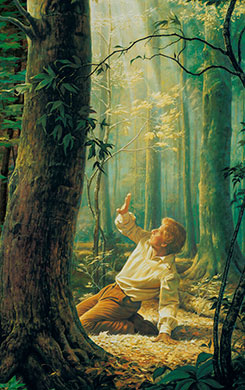
This Church began with the humble prayer of the boy Joseph Smith
in the grove of his father’s farm. From that remarkable experience,
which we call the First Vision, has grown this work. … It is the very
personification of Daniel’s vision of a stone cut out of the mountain
without hands rolling forth to fill the whole earth (see Daniel 2:44–45).3
When
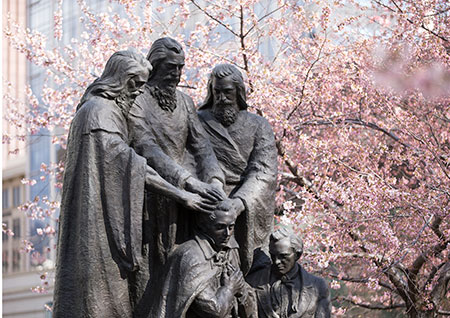
the Church was organized in 1830 there were but six members [and] only a
handful of believers, all residing in a largely unknown village. …
Stakes of Zion today flourish in every state of the United States, in
every province of Canada, in every state of Mexico, in every nation of
Central America and throughout South America.
Congregations
are found throughout the British Isles and Europe, where thousands have
joined the Church through the years. This work has reached out to the
Baltic nations and on down through Bulgaria and Albania and other areas
of that part of the world. It reaches across the vast area of Russia. It
reaches up into Mongolia and all down through the nations of Asia into
the islands of the Pacific, Australia, and New Zealand, and into India
and Indonesia. It is flourishing in many of the nations of Africa. …
And this is only the beginning. This work will continue to grow and prosper and move across the earth.4
2
Early Church leaders had a prophetic view of the destiny of the Lord’s work.
On
July 24, 1847, the pioneer company of our people came into [the Salt
Lake] valley. An advance group had arrived a day or two earlier. Brigham
Young arrived on Saturday. The next day, Sabbath services were held
both in the morning and in the afternoon. There was no hall of any kind
in which to meet. I suppose that in the blistering heat of that July
Sunday they sat on the tongues of their wagons and leaned against the
wheels while the Brethren spoke. The season was late, and they were
faced with a gargantuan and immediate task if they were to grow seed for
the next season. But President Young pleaded with them not to violate
the Sabbath then or in the future.
The
next morning they divided into groups to explore their surroundings.
Brigham Young, Wilford Woodruff, and a handful of their associates hiked
from their campground. … They climbed a dome-shaped peak, President
Young having difficulty because of his recent illness.
When
the Brethren stood on the summit, they looked over [the] valley to the
south of them. It was largely barren, except for the willows and rushes
that grew along the streams that carried water from the mountains to the
lake. There was no building of any kind, but Brigham Young had said the
previous Saturday, “This is the place.”
The
summit where they stood was named Ensign Peak out of reference to these
great prophetic words of Isaiah: “And he [speaking of God] will lift up
an ensign to the nations from far, and will hiss unto them from the end
of the earth: and, behold, they shall come with speed swiftly.” (Isa. 5:26.)
“And
he shall set up an ensign for the nations, and shall assemble the
outcasts of Israel, and gather together the dispersed of Judah from the
four corners of the earth.” (Isa. 11:12.) …
I
think [those Brethren] may also on that occasion have spoken of the
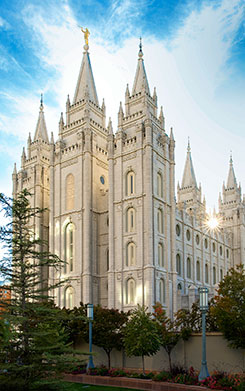
building of the temple … in fulfillment of the words of Isaiah:
“And
it shall come to pass in the last days, that the mountain of the Lord’s
house shall be established in the top of the mountains, and shall be
exalted above the hills; and all nations shall flow unto it.
“And
many people shall go and say, Come ye, and let us go up to the mountain
of the Lord, to the house of the God of Jacob; and he will teach us of
his ways, and we will walk in his paths: for out of Zion shall go forth
the law, and the word of the Lord from Jerusalem.” (Isa. 2:2–3.)
How
foolish, someone might have said, had he heard these men that July
morning of 1847. They did not look like statesmen with great dreams.
They did not look like rulers poring over maps and planning an empire.
They were exiles, driven from their fair city on the Mississippi [River]
into this desert region of the West. But they were possessed of a
vision drawn from the scriptures and words of revelation.
I
marvel at the foresight of that little group. It was both audacious and
bold. It was almost unbelievable. Here they were, almost a thousand
miles [1,600 kilometers] from the nearest settlement to the east and
almost eight hundred miles [1,300 kilometers] from the Pacific Coast.
They were in an untried climate. The soil was different from that of the
black loam of Illinois and Iowa, where they had most recently lived.
They had never raised a crop here. They had never experienced a winter.
They had not built a structure of any kind. These prophets, dressed in
old, travel-worn clothes, standing in boots they had worn for more than a
thousand miles from Nauvoo to this valley, spoke of a millennial
vision. They spoke out of a prophetic view of the marvelous destiny of
this cause. They came down from the peak that day and went to work to
bring reality to their dream.5
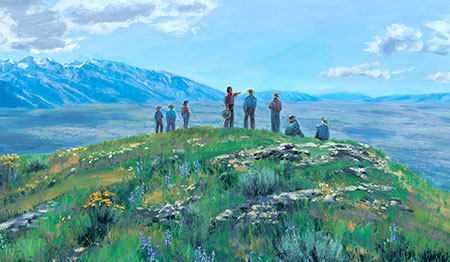
Two
days after arriving in the Salt Lake Valley, Brigham Young and several
other brethren climbed a dome-shaped hill, which became named Ensign
Peak, and surveyed their surroundings.
3
We must never lose sight of the divine destiny of God’s work and the part we play in it.
Sometimes
in our day, as we walk our narrow paths and fill our little niches of
responsibility, we lose sight of the grand picture. When I was a small
boy, draft horses were common. An important part of the harness was the
bridle. On the bridle were blinders, one on each side. They were so
placed that the horse could see only straight ahead and not to either
side. They were designed to keep him from becoming frightened or
distracted and to keep his attention on the road at his feet.
Some
of us do our work as if we had blinders on our eyes. We see only our
own little narrow track. We catch nothing of the broader vision. Ours
may be a small responsibility in the Church. It is good to fulfill that
responsibility with diligence. And it is also good to know how that
responsibility contributes to the great overall program of the growing
kingdom of God.
President Harold B. Lee once said … , quoting an unknown writer, “Survey large fields and cultivate small ones.”
My
interpretation of that statement is that we ought to recognize
something of the breadth and depth and height—grand and wonderful, large
and all-encompassing—of the program of the Lord, and then work with
diligence to meet our responsibility for our assigned portion of that
program.
Each
of us has a small field to cultivate. While so doing, we must never
lose sight of the greater picture, the large composite of the divine
destiny of this work. It was given us by God our Eternal Father, and
each of us has a part to play in the weaving of its magnificent
tapestry. Our individual contribution may be small, but it is not
unimportant. …
… While
you are performing the part to which you have been called, never lose
sight of the whole majestic and wonderful picture of the purpose of
this, the dispensation of the fulness of times. Weave beautifully your
small thread in the grand tapestry, the pattern for which was laid out
for us by the God of heaven. Hold high the standard under which we walk.
Be diligent, be true, be virtuous, be faithful, that there may be no
flaw in that banner.
The
vision of this kingdom is not a superficial dream in the night that
fades with the sunrise. It is veritably the plan and work of God our
Eternal Father. It has to do with all of His children.
While
grubbing the sagebrush of these western valleys [of Utah] to lay the
foundations for a commonwealth, while doing all of the many mundane
things they were required to do to stay alive and grow, our [pioneer]
forebears ever kept before them the grandeur of the great cause in which
they were engaged. It is a work which we must do with the same vision
they held. It is a work which will go on after we have left this scene.
God help us to do our very best as servants, called under His divine
will, to carry forward and build the kingdom with imperfect hands,
united together to execute a perfect pattern.6
4
We can become as an ensign to the nations from which the people of the earth may gather strength.
My
brethren and sisters, the time has come for us to stand a little
taller, to lift our eyes and stretch our minds to a greater
comprehension and understanding of the grand millennial mission of this
The Church of Jesus Christ of Latter-day Saints. This is a season to be
strong. It is a time to move forward without hesitation, knowing well
the meaning, the breadth, and the importance of our mission. It is a
time to do what is right regardless of the consequences that might
follow. It is a time to be found keeping the commandments. It is a
season to reach out with kindness and love to those in distress and to
those who are wandering in darkness and pain. It is a time to be
considerate and good, decent and courteous toward one another in all of
our relationships. In other words, to become more Christlike.7
Unless
the world alters the course of its present trends (and that is not
likely); and if, on the other hand, we continue to follow the teachings
of the prophets, we shall increasingly become a peculiar and distinctive
people of whom the world will take note. For instance, as the integrity
of the family
crumbles under worldly pressures, our position on the sanctity of the
family will become more obvious and even more peculiar in contrast, if
we have the faith to maintain that position.
As
the growing permissive attitude toward sex continues to spread, the
doctrine of the Church, as consistently taught for more than a century
and a half, will become increasingly singular and even strange to many.
As
the consumption of alcohol and the abuse of drugs increase each year
within the mores of our society, our position, set forth by the Lord
more than a century and a half ago, will become more unusual before the
world. …
As
the Sabbath increasingly becomes a day of merchandising and
entertainment, those who obey the precept of the law, written by the
finger of the Lord on Sinai and reinforced by modern revelation, will
appear more unusual.
It
is not always easy to live in the world and not be a part of it. We
cannot live entirely with our own or unto ourselves, nor would we wish
to. We must mingle with others. In so doing, we can be gracious. We can
be inoffensive. We can avoid any spirit or attitude of
self-righteousness. But we can maintain our standards. …
As
we observe these and other standards taught by the Church, many in the
world will respect us and find strength to follow that which they too
know is right.
And,
in the words of Isaiah, “Many people shall go and say, Come ye, and let
us go up to the mountain of the Lord, to the house of the God of Jacob;
and he will teach us of his ways, and we will walk in his paths.” (Isa. 2:3.)
We
need not compromise. We must not compromise. The candle that the Lord
has lighted in this dispensation can become as a light unto the whole
world, and others seeing our good works can be led to glorify our Father
in Heaven and emulate in their own lives the examples they have
observed in ours.
Beginning
with you and me, there can be an entire people who, by the virtue of
our lives in our homes, in our vocations, even in our amusements, can
become as a city upon a hill to which men may look and learn, and an
ensign to the nations from which the people of the earth may gather
strength.8
If
we are to hold up this Church as an ensign to the nations and a light
to the world, we must take on more of the luster of the life of Christ
individually and in our own personal circumstances. In standing for the
right, we must not be fearful of the consequences. We must never be
afraid. Said Paul to Timothy:
“For God hath not given us the spirit of fear; but of power, and of love, and of a sound mind.
“Be not thou therefore ashamed of the testimony of our Lord” (2 Timothy 1:7–8).9
You
cannot simply take for granted this cause, which is the cause of
Christ. You cannot simply stand on the sidelines and watch the play
between the forces of good and evil. …
… I
urge you with all the capacity that I have to reach out in a duty that
stands beyond the requirements of our everyday lives; that is, to stand
strong, even to become a leader in speaking up in behalf of those causes
which make our civilization shine and which give comfort and peace to
our lives. You can be a leader. You must be a leader, as a member of
this Church, in those causes for which this Church stands. Do not let
fear overcome your efforts.10
We
have nothing to fear. God is at the helm. He will overrule for the good
of this work. He will shower down blessings upon those who walk in
obedience to His commandments. Such has been His promise. Of His ability
to keep that promise none of us can doubt.
… Our
Savior, who is our Redeemer, the Great Jehovah, the mighty Messiah, has
promised: “I will go before your face. I will be on your right hand and
on your left, and my Spirit shall be in your hearts, and mine angels
round about you, to bear you up” (D&C 84:88).
“Therefore,”
said He, “fear not, little flock; do good; let earth and hell combine
against you, for if ye are built upon my rock, they cannot prevail. …
“Look unto me in every thought; doubt not, fear not.
“Behold
the wounds which pierced my side, and also the prints of the nails in
my hands and feet; be faithful, keep my commandments, and ye shall
inherit the kingdom of heaven” (D&C 6:34, 36–37).
Unitedly,
working hand in hand, we shall move forward as servants of the living
God, doing the work of His Beloved Son, our Master, whom we serve and
whose name we seek to glorify.11
We
must stand firm. We must hold back the world. If we do so, the Almighty
will be our strength and our protector, our guide and our revelator. We
shall have the comfort of knowing that we are doing what He would have
us do. Others may not agree with us, but I am confident that they will
respect us. We will not be left alone. There are many [who are] not of
our faith but who feel as we do. They will support us. They will sustain
us in our efforts.12
Let
us glory in this wonderful season of the work of the Lord. Let us not
be proud or arrogant. Let us be humbly grateful. And let us, each one,
resolve within himself or herself that we will add to the luster of this
magnificent work of the Almighty, that it may shine across the earth as
a beacon of strength and goodness for all the world to look upon.13
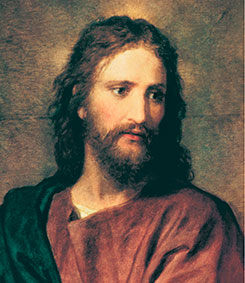
“If
we are to hold up this Church as an ensign to the nations and a light
to the world, we must take on more of the luster of the life of Christ.”
Suggestions for Study and Teaching
Questions
-
•
As you read section 1, what are your feelings as you consider the growth of the Church from 1830 to the present day?
-
•
Review President Hinckley’s account of the first pioneers arriving in the Salt Lake Valley (see section 2). What can we learn from this account? How have we benefited from the prophetic vision of early Church leaders? What do you think it means to be “an ensign to the nations”? (See Isaiah 5:26; 11:12.)
-
•
In section 3, President Hinckley encouraged us to see the “grand picture” and “broader vision” of God’s work. Why do we need to see this grand picture? Why do we sometimes lose sight of it? In what ways can our small efforts contribute to the growth of God’s kingdom?
-
•
Review the ways President Hinckley says Latter-day Saints are becoming a more “peculiar and distinctive people” (section 4). How can we develop greater vision and courage in moving God’s work forward? How can we live in the world without being of the world? How can we “take on more of the luster of the life of Christ”? Why is it important for us to stand for what is right?
Related Scriptures
Teaching Help
“Be
sure you don’t believe you are the ‘true teacher.’ That is a serious
mistake. … Be careful you do not get in the way. The major role of a
teacher is to prepare the way such that the people will have a spiritual
experience with the Lord” (Gene R. Cook, quoted in Teaching, No Greater Call [1999], 41).